
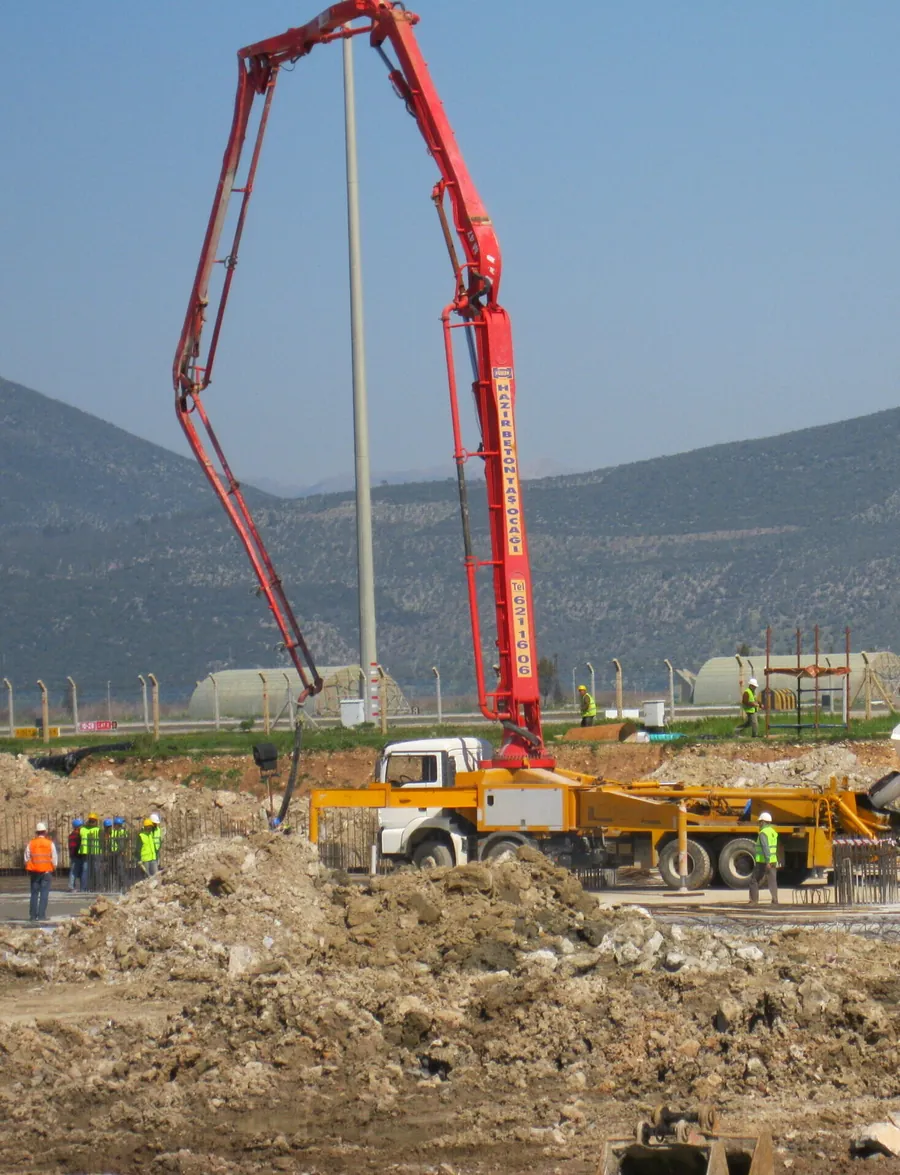
Where a pour goes wrong, the problem is usually not the concrete; it is that no thought was given beforehand to how the concrete would reach the formwork. The pump does not fit in the street, there is no room to extend the outriggers, the boom will not reach the last column, the mixer truck cannot reverse. All of these could be settled in half an hour a week before pour day, with a sketch in your hand. Choosing a pump is not a plant hire decision but an access planning decision: once you know from which point, over what distance, at what height and on what ground you will be delivering the concrete, the right machine becomes obvious.
Types of Concrete Pump: Boom, Line Pump and Hybrid Solutions
There are three common ways of getting concrete to a site: discharging directly from the mixer truck, carrying it by skip and crane, and pumping it. The first two work on small volumes and where access is easy. Above a certain volume and height a pump is no longer a convenience but a necessity that keeps the pour continuous, because concrete reaching the formwork without interruption prevents unplanned cold joints.
Mobile boom pump (truck-mounted pump): On a truck chassis it carries a folding boom with a fixed pipeline running through it. You position the truck, extend the outriggers, unfold the boom and deliver the concrete directly over the formwork. There is no pipeline to erect; setting up and packing down are measured in minutes. It is the standard solution for the great majority of jobs such as housing, commercial buildings, villas, raft foundations and yard slabs. In return it demands a generous footprint: the truck itself, its extended outriggers and the airspace the boom will swing through.
Line pump (stationary pump): It has no boom. It carries the concrete to wherever you want it through a line of steel pipe and hose assembled by hand on site. Trailer-mounted models, or those on a small truck, can get into a narrow street, down to a basement or inside an existing building. It works everywhere a boom pump cannot reach: under a covered car park, in a tight garden, on plots where the rear elevation is reached through the existing building, for screeds and levelling concrete within a floor, and at points the tower crane cannot serve. The price is labour: erecting the line, fixing it, and dismantling and washing it out after the pour all take time.
Hybrid use: Attaching extra hose to the end of a boom pump does not give as much freedom as people assume; the longer the hose, the greater the pressure loss and the risk of whipping. Instead, on some jobs the boom pump is positioned outside the building and a pipeline is laid to a critical point; on others a vertical line is set up with a line pump to reach the floor level, and distribution within the floor is done by hose. On tall, long-running projects a permanent vertical line and a floor-mounted placing boom are also installed; that is economic not for one-off pours but for regularly repeated floor pours.
The question that decides the choice is this: can you reach the farthest and highest point of the formwork from somewhere the truck can park? If the answer is yes, a boom pump; if not, a line pump is the discussion.
How Do You Read Boom Length and Reach Radius?
The metre figure in a pump's name is almost always the vertical reach: how high above the ground the end of the hose can be taken with the boom fully extended. The number that is actually useful on site, though, is usually the horizontal reach radius, and that figure is a few metres shorter than the vertical reach. A pump's reach diagram is a curve showing where the boom can get to at each angle; ask for that diagram when you take a quotation, and do not decide on a single metre figure.
The second and most common mistake is measuring the radius from the wrong place. The reach radius is measured not from the front of the truck or the outer end of the outriggers, but from the boom's slewing axis. That axis is somewhere around the middle of the truck. So even if the pump pulls up to the edge of the plot, the slewing axis stays a few metres back from the edge of the formwork. The distance you need to measure on your sketch is from that axis, at the point where the pump will stand, to the farthest corner of the formwork.
The third point is that height eats radius. A boom cannot rise and extend to its full length at the same time; the higher it goes, the shorter its horizontal reach. A machine that reaches a ground-floor raft comfortably may not reach an upper-floor slab at the same horizontal distance. Allow not for the farthest point of the formwork, but for the farthest and highest point.
The way the boom folds also makes a difference on site. Booms whose sections fold back on one another (roll-fold) can open in a tight space and under a low obstruction, because they take up little room above them as they unfold. A conventional Z-fold boom needs more free space overhead to open. Under trees, under eaves, under power lines and close to a neighbouring elevation, this distinction determines the choice outright; ask the pump owner not only for the metre figure but “this obstruction is here, can it unfold in this space?”.
Finally, keep the sizing on the safe side. Choosing a machine without adding an allowance to the distance you measured means the boom failing to make the last two metres on pour day; at that point you are left with nothing but bad options. The extra cost of the next size up is small beside the cost of a half-finished pour.
Which Pump for Which Job?
The decision looks at four variables: volume, height, distance and access.
- Raft foundations, yard slabs, large floor slabs: The concrete has to arrive quickly and without interruption. A boom pump is first choice; because the boom is also the distribution tool, the crew does not shovel the concrete about, it is placed directly at every point of the formwork.
- Pouring walls and columns: The boom pump is superior in that it can lower the end of the hose into the formwork. Concrete free-falling from a height segregates; with a boom the drop height can be controlled.
- Villas, detached buildings, tight garden plots: A boom pump if there is room for the truck around the plot; a line pump if there is not, or if landscaping and existing buildings prevent the truck from getting close.
- Basement, enclosed car park, an area reached through an existing building: line pump. A boom cannot deliver concrete into a covered space.
- Screed within a floor, levelling concrete, lightweight fill concrete: line pump. The volume is small and the distance is long; a boom pump is rarely economic.
- Floor pours in a tall building: A vertical line with a floor-mounted placing boom, or a long-reach boom pump. A tower crane and skip become too slow as the volume grows.
- Small, easily accessible pours: Discharging directly down the chute from the mixer truck may be enough. The decision to use a pump is made by comparing the volume with the set-up time.
There is a second balance on the volume side: the pump's output and the mixer truck cycle have to match. A pump that is very fast on paper cannot use that speed if only one mixer truck at a time can get into the street; while it waits, the concrete in the line loses consistency. Consider the total volume, the mixer truck capacity and the round-trip time between the batching plant and the site together. For the cubic metre calculation and the steps involved in ordering, see our article on how to order concrete.
Consistency is part of the pump decision too. Concrete that is to be pumped is designed differently even at the same strength class: the fines content and the admixture are adjusted separately. A long line, a high floor and a route with many bends are all things that need to be stated when ordering. For the consistency classes and what makes pumped concrete different, you will find detail in our article on consistency classes and pumped concrete.
Outrigger Ground: The Real Cause of Overturning
The safety of a boom pump depends on the bearing capacity of the ground under its outriggers. This is the most underestimated and most expensive issue on site. When the boom extends in one direction the truck's weight is not shared evenly; most of the load goes onto a single outrigger on that side. In other words, one outrigger can carry a significant part of the truck's total weight. If the ground gives way at that point, the pump overturns.
Check three things separately.
- The type of ground: There is a world of difference between natural, compacted ground and freshly placed fill. An area backfilled after excavation will settle under an outrigger even if it looks level on top. Clay soil saturated after rain falls far below its dry bearing capacity.
- Hidden voids: Inspection chamber and manhole covers, septic tanks, sewer and service trenches, water and natural gas lines, an old well, the ground immediately beside a basement wall. Setting an outrigger on a cover means the cover breaking and the outrigger dropping into the void. Mark the service lines on the site sketch.
- Excavations and batter edges: The rule of thumb generally accepted for approaching the edge of an open excavation is to stay back by a distance equal to the excavation depth. If the machine must bear closer to the edge, shoring and a ground assessment are required. The ground behind a retaining wall is equally risky; the wall may not have been designed for the load of heavy plant passing over it.
Packing plates are placed under the outrigger pads to spread the load. The logic is simple: the plate area required is the outrigger load divided by the safe bearing capacity of the ground. The weaker the ground, the larger the plate. Two mistakes are seen in practice: using small timber packers of insufficient area, and stacking packers unevenly on top of one another. The packing must be large enough to take the whole outrigger pad, free of cracks and even; and the outrigger must bear on the middle of the packing. On soft ground, steel or composite spreader plates are preferred.
Whether the outriggers can be fully extended is a separate question. In a narrow street they are often set with a half spread on one side. That does not mean the machine cannot work; but when the boom slews towards the restricted side its capacity is limited, or that direction is closed off altogether. If you are going to work with a half spread, agree in advance which way the concrete will be delivered; the assumption that “it will swing round somehow” is a dead end on pour day. When you work out the area the outriggers need, include the path they sweep as they extend; a parked car or a garden wall alongside can block the spread.
Power Lines, Trees and Narrow Street Constraints
On a site survey the eyes look down; yet the boom works up above. Before deciding on the position, lift your head and study the space above the truck.
Overhead power lines. The boom does not have to touch the line; at high voltage, electricity can arc through the air once a certain distance is approached. Safe approach distances are therefore defined by regulation according to the voltage level, and cannot be judged by eye on site. If there is a line, the action is clear: position the pump outside the line's reach; if that is not possible, ask the distribution company to de-energise or insulate the line for the duration of the pour. The boom operator is never left alone; a banksman on the ground watches the line continuously. Wet concrete and steel pipe conduct; in the event of contact the danger extends not only to the operator but to the crew at the end of the hose.
Trees, eaves, signs, cable bundles. The path the boom follows as it unfolds is more restricted than its position once opened. Roll-fold booms are an advantage beneath low branches and eaves. If pruning is needed, municipal permission can take days; that is one more reason to carry out the site survey early.
Narrow streets and manoeuvring. A common situation along the Bodrum and Milas corridor is that the plot is suitable but the street is narrow. The checklist runs as follows: the clear width and turning radius the pump truck needs to enter the street; the extra width required for the outriggers to extend; the straight distance the mixer truck needs in order to reverse up to the pump hopper; a lay-by or nearby area where the following mixer trucks can wait; whether the street is one-way; and a temporary parking ban obtained from the municipality or the neighbourhood headman so that parked vehicles can be moved. Bear in mind that in summer the streets of tourist settlements fill up and time restrictions may apply; an early pour is an advantage in terms of both traffic and temperature.
Slope. The slope of the ground the pump stands on must be within the limit defined by the manufacturer. On a sloping road the machine can be levelled by setting the outriggers to different lengths; this, however, increases the load on the downhill outrigger and makes checking the ground more critical still.
The particular constraints of a line pump's pipeline. The line is made up of straight pipe sections and hoses. Every bend and every extra metre of hose creates pressure loss; set the line out as straight and as short as possible and avoid unnecessary bends. On vertical runs the line must be clamped to the structure; the impulse created as the concrete travels through moves an unrestrained pipe. Bridge over the line wherever people or plant must cross it, and never drive a vehicle over the pipe. Nobody stands in front of the line or at its end: when the pressure is released after a blockage, the last hose can whip.
Pre-pour Survey Checklist
The survey is carried out before the pump is booked, and preferably completed on foot on site, together with a representative of the pump company or technical staff from the batching plant. Put the headings below down on paper, so that nothing comes as a surprise on pour day.
- Formwork sketch and critical point: The layout of the elements to be poured, the farthest point, the highest point, and the distance of that point from where the pump will stand.
- Volume and pour duration: The total cubic metres, the planned hourly rate, how many hours the pour will take, and the number and spacing of mixer trucks.
- Pump set-up point: The type of ground, service lines, distance to the excavation edge, slope, the area needed for the outrigger spread, and the need for packing.
- Overhead obstructions: Power lines, trees, eaves, signs, the neighbouring elevation; the path the boom takes as it unfolds.
- Mixer truck traffic: The route in and out, the reversing distance, the waiting area, the road width, permits, and the gradient out onto the street.
- Water: A water supply and hose for washing out the pump and the line; if there is no water, a tanker plan.
- Waste concrete and washout water: A pre-agreed discharge point that does no environmental harm, for the concrete left in the line and the washout waste. It is never discharged into the sea, into a stream or into a stormwater gully.
- Pour sequence and crew: Which area first, who is on the vibrator, who is on the screed, how many people, who the banksman is, and the radio or hand-signal arrangement.
- Contingency plan: What to do if the pump breaks down, whether there is a second vibrator, whether a generator is needed, and whether lighting is ready if the pour runs long.
- Weather: The temperature, wind and rainfall forecast for pour day. On a hot, windy day the curing plan, and on a cold day the protection plan, is set up in advance. For detail see our articles on pouring in hot weather and cold-weather precautions.
Most of the items on this list take five minutes; but skipping one of them can stop the pour for hours. An interrupted pour means an unplanned cold joint, and that joint remains the weak link for the life of the structure.
Pour Day: Positioning, Setting Up the Line and Washing Out
The pump arrives on site ahead of the first mixer truck. The operator brings the truck to the planned position, sets the outriggers to their full spread or to the half spread agreed, places the packing and levels the truck. The boom is not unfolded until this step is complete. Once the set-up is finished the outrigger areas are taped off; nobody stands around an outrigger pad and no material is stacked in that area.
Before the line starts work, the inside of the pipe is primed: water and then cement grout or mortar is pumped through to form a lubricating layer on the pipe wall. This first material is not discharged into a reinforced concrete element; it is taken away separately. In the same way, at the end of the pour the concrete left in the line is pushed out with a sponge ball and discharged not into the structure but at the designated waste point. Cleaning the line with compressed air is dangerous and is done only by trained personnel, with nobody at the end of the line.
Points to watch during the pour:
- Drop height: The end of the hose is kept as close to the formwork as possible. If concrete free-falls from a height the coarse aggregate segregates, and the mix scatters as it strikes the reinforcement. In deep walls and columns the hose is lowered into the formwork, or a hose extension is used.
- Leave horizontal movement to the pump: Concrete is not dumped in one place and spread with the vibrator. A vibrator is a compaction tool, not a shovel; dragging concrete sideways with vibration causes segregation. The boom should deliver the concrete straight to where it belongs.
- Layer thickness: In walls and columns the concrete is placed in layers suited to the effective depth of the vibrator; each layer is compacted so that it penetrates slightly into the one below.
- Interruptions: If a delay to a mixer truck is unavoidable, the line is cycled at intervals so that the concrete in it does not begin to set. If the wait is long the line is emptied and cleaned; priming is repeated when the pour restarts.
- Communication: The boom operator cannot always see inside the formwork. Appoint one banksman; everyone raising a hand and pointing is a cause of accidents.
At the end of the pour the boom is folded, the outriggers are raised and the site is cleared. Finishing the surface, curing and cutting the joints follow a separate timetable; when the pump leaves the site, the stage that determines the quality of the job has only just begun.
If you tell us what pump you need, your formwork sketch and your pour time when you order, we will plan together which size of machine suits your job and how the mixer truck cycle will be arranged; for the access plan and the mix design, contact the Bodrum Beton technical team before pour day.
Frequently asked questions
What does a boom pump's metre figure mean, and is the horizontal reach the same?
The metre figure in a pump's name is almost always the vertical reach; the horizontal reach radius is a few metres shorter than that. The radius is also measured not from the front of the truck but from the boom's slewing axis, and the horizontal reach falls as the height rises. Ask for the machine's reach diagram before you decide.
Which is cheaper, a line pump or a boom pump?
Look at the total cost rather than the hire rate. Because its set-up and pack-down times are short, a boom pump works out cheaper on large-volume jobs with open access. A line pump takes time because of the labour of erecting and dismantling the line; but it is the only solution in basements, within floors and in places with restricted access, and it can be more economic on small volumes.
Can a pump outrigger bear on a manhole cover?
No, it should not. The top of an inspection chamber, a manhole or a service trench is a void; the cover is not designed for the point load of a heavy machine's outrigger. Mark the service lines during the survey, keep the outrigger positions clear of them, and use a load-spreading plate wherever the ground is unknown.
Can I pour beneath a power line?
The boom does not have to touch the line; at high voltage electricity can arc once a certain distance is approached. Safe approach distances are defined by regulation according to voltage and cannot be judged by eye on site. Position the pump outside the line's reach; if that is not possible, ask the distribution company to de-energise the line.
Will the pump not work if the outriggers are not fully extended?
Most machines can work with a half spread; but when the boom slews towards the restricted side its capacity falls, or that direction is closed off altogether. Which way the concrete will be delivered must therefore be discussed before the set-up. A half spread should be a plan decided at the survey, not a decision the operator takes at the moment of pouring.
What should I do if the pump breaks down during the pour?
Discuss the contingency plan at the survey: how quickly a second pump nearby could arrive, how the remaining section would be divided, and where the break would run, are all decided in advance. If an interruption is unavoidable, stop the pour not at a random point but at one that is structurally suitable; the joint surface formed is then cleaned and work continues with bond restored.
Related articles
Formwork Striking Times: When to Strike, and the Risk of Early Loading
Industrial Floor Concrete: Hardener, Joints and Flatness
Concrete Cracks: Types, Causes and Ways to Prevent Them
Concrete Consistency Classes: The Slump Test, S1-S5 and Pump Concrete
Pouring Concrete in Winter: Cold-Weather Precautions and Freezing Risk
Water/Cement Ratio: Why Does Excess Water Weaken Concrete?
How to Order Concrete: m³ Calculation, Pump Selection and Pour Day
What Is Concrete Curing? A Guide to Hot-Weather Pouring and Curing
Need concrete for your project?
Contact our sales team for mix design, delivery planning and a price quote. Fast delivery from our Milas / Muğla plants to the Bodrum, Milas, Ören and Güllük line.