
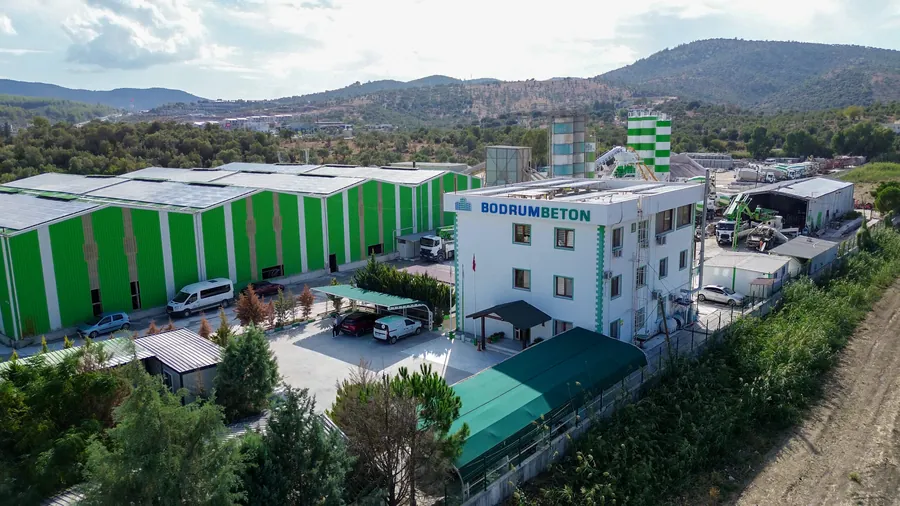
Concrete is poured in winter too; but if it is poured with summer habits, the price is high. The hardening of cement is a chemical reaction and, like every reaction, it slows down in the cold and almost stops at freezing point. The problem does not end with slowing down: if concrete that has not yet gained enough strength freezes, the water inside it turns to ice and breaks up the paste, and the strength lost never comes back. Bodrum's winter is mild compared with Anatolia; but on days when the night temperature drops, the wind does not let up and humidity rises, fresh concrete faces a threat it never sees in summer. Precautions are taken at the plant and on site together, before the truck mixer arrives at the gate.
Hydration and Temperature: Why Does Concrete Harden Slowly in the Cold?
When cement combines with water, a series of chemical reactions called hydration begins; the hardening of concrete and its gain in strength are the result of these reactions. The rate of reaction depends on temperature. As a rough rule, for every 10 °C drop in concrete temperature the rate of hydration roughly halves. The strength gained in one day at 20 °C is spread over two days at 10 °C and three to four days at 5 °C. As 0 °C approaches the reaction becomes very slow; below freezing point the free water freezes and the reaction effectively stops.
This slowing down does not by itself spoil the concrete. Concrete that hardens slowly in the cold picks up where it left off when the temperature rises and reaches its target strength in time; indeed, slowly cured concrete develops a denser internal structure. The problem lies in three consequences of the slowdown: because the setting time is longer, the concrete stays plastic for a long time and surface finishing is delayed by hours; formwork striking and loading times are extended and the programme slips; and most importantly, the concrete remains vulnerable for far longer before it becomes resistant to freezing.
Standards define cold-weather concreting as conditions in which the average air temperature stays below 5 °C for several consecutive days. On site, however, the criterion to go by is the concrete temperature, not the air temperature. At the moment of delivery the concrete temperature is generally required not to fall below 5 °C; in thick sections this limit is set slightly lower, in thin sections higher. Keeping a concrete thermometer on site is the cheapest tool for the winter pour decision.
Freezing Risk and the Critical Strength Threshold
Water in fresh concrete exists in two states: the water that will react with the cement and the free water in the voids. If the concrete freezes before it has hardened enough, the free water turns to ice and its volume increases by roughly nine per cent. This expansion breaks up the still weak cement paste from the inside; the bond between aggregate and paste is broken, the surface scales and a porous, brittle structure forms inside. When the ice thaws the reaction continues, but the broken structure never regains its original integrity. Concrete that freezes early suffers a permanent and serious loss of final strength; in some cases the concrete has to be broken out and re-poured.
A critical threshold is therefore defined: before its first exposure to freezing, the concrete must have reached a compressive strength of roughly 3.5-5 N/mm². In concrete that has reached this threshold the free water has largely been consumed and the paste has hardened enough to resist the expansion of ice; a single freeze-thaw cycle leaves no permanent damage. Under normal conditions this strength is reached in one day at 20 °C; at 5 °C it takes two to three days, and longer in colder weather. Throughout this period the concrete temperature must be kept above 0 °C, and preferably above 5-10 °C. The critical threshold does not mean "curing is now over"; moist, warm curing has to continue for the target strength to be reached.
Where does freezing strike hardest? In thin sections (slabs, eaves, stairs, thin walls), at corners and edges, on unformed top surfaces, on faces exposed to the wind and in areas in contact with cold ground or cold reinforcement. A thick raft protects itself with its own heat of hydration; a ten-centimetre slab left unprotected can freeze in a single night.
The Bodrum Winter: Short, Damp and Windy
Around Bodrum and Milas the winter is short compared with inland regions, and daytime temperatures mostly stay above 10 °C. This mildness is deceptive. Three local features make winter dangerous for fresh concrete.
The first is the difference between day and night. A site that sees 15 °C at midday on a sunny winter day can drop to 2-3 °C on a clear night, and below freezing in the hill villages and the inland parts of Milas. A slab poured in the afternoon goes through the coldest hours at midnight, before it has reached its critical strength. The second is wind. The poyraz north-easterly and the lodos south-westerly draw heat from the surface of the concrete regardless of the air temperature; 5 °C with wind can be harder on concrete than 0 °C in still air. Wind also speeds up evaporation from the surface and opens plastic shrinkage cracks even in winter; the enemy you know from hot weather comes in disguise in winter. The third is humidity and rain. Winter rain washes the fresh concrete surface, collects water in the formwork, saturates the ground and reduces the insulation value of coverings. A wet blanket does not insulate; it cools.
In conclusion: in Bodrum, cold-weather precautions are tied to the weather forecast, not the calendar. If the night temperature on pour day will drop below 5 °C, if the wind is strong or if rain is expected, the precautions below come into effect. Between December and February these conditions are frequent, and they occur from time to time in November and March. You can find the summer counterpart of these measures in the article on pouring in hot weather; anyone who reads the two articles together will make the right decision all year round.
Mix-Side Precautions: What Changes at the Plant?
Cold-weather concrete does not begin with spreading blankets over standard concrete on site; the mix design changes at the plant. When you state at the time of ordering that the weather will be cold, the plant brings the following tools into play.
- Hot mixing water: The most practical way of raising the concrete temperature is to heat the mixing water. Water both heats more easily than aggregate and carries more heat per unit of mass. However, because very hot water in direct contact with cement can cause flash setting and balling, the water temperature is limited; the water is mixed with the aggregate first and the cement is added afterwards.
- Heated or unfrozen aggregate: Aggregate is the largest mass in the mix; concrete produced with frozen, ice-bound aggregate is both cold and uncontrollably wet. At the plant, aggregate stockpiles are covered and, if necessary, heated with steam or hot air. No lumps of ice are accepted in the concrete.
- Set-accelerating admixture: Speeds up hydration so that the concrete reaches its critical strength earlier, shortening the setting time that cold weather extends. Chloride-free accelerators are used in reinforced concrete; calcium chloride triggers reinforcement corrosion and is not used in reinforced elements. An accelerator is not an antifreeze; it does not stop the concrete freezing, it speeds up strength gain before freezing can occur.
- Air-entraining admixture: Creates microscopic, evenly distributed air bubbles inside the concrete. These bubbles give freezing water room to expand and so protect the hardened concrete against freeze-thaw cycles. They are particularly valuable in external concrete that will freeze and thaw repeatedly over the winter (yard slabs, steps, the top surfaces of retaining walls). Because air entrainment lowers strength somewhat, the mix is redesigned accordingly.
- Cement type and content: Cement with high early strength (for example CEM I 42.5 R class) generates heat and gains strength faster in the cold. Slag and pozzolanic cements with a slow heat of hydration are an advantage in summer but can become a disadvantage in winter. Increasing the cement content somewhat and lowering the water/cement ratio supports both heat generation and early strength.
- Low water/cement ratio: Less free water means less water to freeze. In winter, as in summer, consistency is achieved with plasticiser, not water; adding water on site is twice as harmful in winter, because it both lowers strength and increases the amount of water that can freeze.
The dosage of these tools is set at the plant according to the temperature forecast, section thickness and haul time. The ready-mix producer's winter mix ensures that the concrete arrives on site at an acceptable temperature; what happens after delivery is the site's responsibility.
Site-Side Precautions: Before and After the Pour
Before the pour. There must be no ice, snow or frost on the formwork, reinforcement or ground; when warm concrete touches frozen reinforcement it cools instantly at the contact surface and bond is impaired. Ice is removed with a hot-air blower or steam; never with salt. Concrete is not poured onto frozen ground; frozen ground settles as it thaws and cracks the concrete. Rainwater collected in the formwork is drained out. Covering material, heaters and a thermometer are on site before the pour starts; looking for blankets after the truck mixer has arrived is too late.
During the pour. The pour is scheduled for the warmest part of the day, ideally from late morning to mid-afternoon, so that the concrete sets for several hours in mild conditions before the night cold. Waiting time on site is kept short; the truck mixer discharges into formwork that is ready. The concrete temperature is measured on the first truck and recorded in the pour log. Placing and compaction are carried out quickly and completely; honeycombed concrete is both weak and prone to freezing.
After the pour: covering. Exposed surfaces are covered as soon as finishing is complete. The aim is to keep the concrete's own heat of hydration inside; the concrete heats itself, and you stop that heat escaping. Insulated concrete blankets, glass wool or polystyrene boards under a polyethylene sheet, and insulation wrapped around the outside of the formwork are used. The covering is closed off completely at edges and corners; heat escapes from the edges first. Laying polyethylene under the covering both retains moisture and prevents the covering from getting wet and losing its insulation value. In windy weather the covering is weighted down; a covering that blows away protects nothing.
After the pour: heating. Where covering is not enough, particularly in thin sections and on nights when frost is expected, an enclosure is built and heated. The slab is closed in with a tent or tarpaulin and a hot-air blower or radiant heater is placed underneath. Two points need care: the heater must not blow directly onto the concrete surface, otherwise the surface dries out and cracks; and combustion heaters produce carbon dioxide in an enclosed space, which carbonates the fresh concrete surface and causes dusting, so a flued heater or an electric system is preferred and the enclosure is ventilated. Heated concrete must not be cooled suddenly; when heating stops, the covering is removed in stages, because a sudden temperature difference leads to thermal cracking.
Curing. Curing is neglected in cold weather; yet concrete needs water in winter too. Because of the risk of the water freezing, moisture-retaining coverings and curing compounds are preferred to wet curing. If the concrete temperature is above 5 °C the curing period is normal; if it is below, the period is extended. Throughout curing, the concrete temperature is measured and recorded at least twice a day, including at the coldest hour.
Formwork Striking Time: Go by Strength, Not the Calendar
The formwork striking times you are used to in summer do not apply in winter. Formwork is struck when the concrete has reached the strength to carry its own weight and the loads on it; in the cold, the time taken to reach that strength can double or triple. A beam side form that is struck after three days at 20 °C can take a week at 5 °C; props under slabs wait even longer. Formwork struck early does harm in two ways: concrete of insufficient strength deflects and cracks under load; and because the formwork also acts as insulation, removing it suddenly exposes the concrete to the cold and the risk of freezing returns.
There are three ways to decide on formwork striking. The first is control specimens cured on site under the same conditions as the concrete; when crushed, these show the concrete's actual strength. Standard laboratory specimens are cured at 20 °C and so do not represent the concrete on site. The second is the maturity method: the temperature history of the concrete is recorded and strength is estimated from the product of temperature and time; it is used on large sites with permanent temperature sensors. The third is approximate checking with non-destructive tests (such as a rebound hammer). If none of these is available, the striking time is set not by the table in the design but by a value extended with a temperature correction, and in case of doubt one more day is waited.
After the formwork is struck, the concrete is still not left uncovered; column and wall surfaces in particular are protected with insulating blankets for a few more days after striking. Striking the formwork does not end the protection period in winter.
Winter Pour Checklist
If you can answer "yes" to every item below before pour day, you are ready:
- I have checked the weather forecast for the pour day and the following three nights; the night temperature, wind and rain are known.
- I have informed the plant that this is a cold-weather pour; hot water, accelerator, air entrainment and cement type have been discussed with the plant.
- The pour is scheduled for the warm part of the day; the formwork and the crew will be ready when the truck mixer arrives.
- No ice, snow or water on the formwork, reinforcement or ground; the ground is not frozen.
- Covering material (insulated blankets, polyethylene, insulation boards) on site in sufficient quantity and dry.
- If needed, heaters, a tent or tarpaulin and fuel are ready; no unflued combustion heaters will be used.
- Concrete thermometer on site; the concrete temperature will be measured on the first truck and recorded in the pour log.
- Control specimens to be cured under site conditions will be taken; the formwork striking decision will be based on these specimens.
- The crew has been told that no water will be added to the concrete on site; the consistency requirement was stated in the order.
- Covering and heating are planned to continue at least until the critical strength is reached, and preferably for three days.
A winter pour is a matter of planning; it does not tolerate improvisation. Talk to the plant before ordering to decide together on the mix side: hot water, suitable cement, accelerator and air-entraining admixture. At Bodrum Beton we adjust the mix to the weather conditions on pour day and deliver the concrete by pump right to your formwork; for technical support on your winter pours you can reach us through our contact page, and you can work out the volume you need in advance with the concrete calculator tool.
Frequently asked questions
Below what temperature is concrete not poured?
There is no fixed prohibited temperature; with precautions in place, concrete is poured even below zero. The practical criterion is the concrete temperature: it should not fall below 5 °C at delivery, and it must be kept above 0 °C, preferably above 5-10 °C, until the critical strength is reached. If the average air temperature falls below 5 °C, cold-weather precautions come into effect.
Does a set accelerator stop concrete from freezing?
No. An accelerator is not an antifreeze; it does not lower the freezing point of concrete to any meaningful degree. What it does is speed up hydration so that the concrete reaches its critical strength sooner. This shortens the time the concrete remains vulnerable; but covering, and heating if necessary, are still needed during that time.
The concrete froze one night, what should I do?
First look at the age of the concrete and its temperature history at the time of freezing. If the concrete froze before reaching its critical strength, the likelihood of permanent damage is high; surface scaling and a brittle structure will be seen. Cores should be taken from the affected area and strength measured, and the decision on local repair or re-pouring made by an engineer according to the result. Concrete that freezes for one night after reaching its critical strength usually suffers no permanent damage; curing and protection are continued.
When can I strike the formwork in winter?
When you are sure the concrete has reached its actual strength. Carrying summer periods over into winter is a mistake; in the cold the period can double or triple. The most reliable way is to crush control specimens cured on site under the same conditions as the concrete. After the formwork is struck, surfaces should still be protected with insulating blankets for a few days.
Are winter precautions really necessary in Bodrum, the weather is not that cold?
Although daytime temperatures are mild, on clear nights the temperature drops to 2-3 °C and below freezing inland; wind and humidity speed up the concrete's heat loss. A thin slab poured in the afternoon is vulnerable at night. Precautions are based not on the calendar but on the weather forecast for pour day and the following three nights; they are frequently needed between December and February.
Are hot-weather precautions and cold-weather precautions the opposite of each other?
Largely, yes: you cool the concrete in summer and warm it in winter; a set retarder is used in summer, an accelerator in winter. Two things are common to both. In both seasons, evaporation from the surface and wind lead to plastic shrinkage cracking, so early covering and curing are essential. In both seasons, adding water on site is prohibited.
Related articles
Choosing a Concrete Pump: Boom, Line Pump and the Access Plan

Formwork Striking Times: When to Strike, and the Risk of Early Loading

Industrial Floor Concrete: Hardener, Joints and Flatness
Concrete Cracks: Types, Causes and Ways to Prevent Them
Concrete Consistency Classes: The Slump Test, S1-S5 and Pump Concrete
Water/Cement Ratio: Why Does Excess Water Weaken Concrete?
How to Order Concrete: m³ Calculation, Pump Selection and Pour Day
What Is Concrete Curing? A Guide to Hot-Weather Pouring and Curing
Need concrete for your project?
Contact our sales team for mix design, delivery planning and a price quote. Fast delivery from our Milas / Muğla plants to the Bodrum, Milas, Ören and Güllük line.