
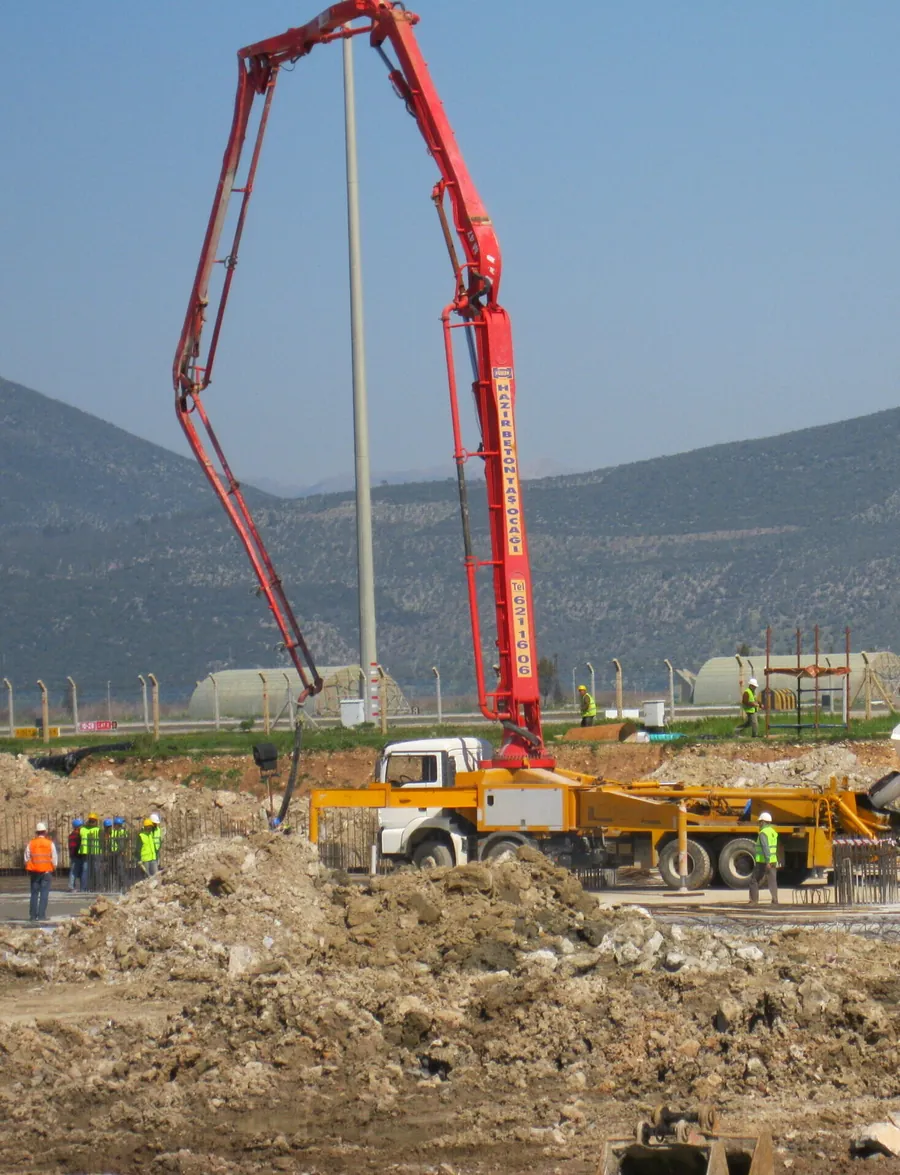
One of the sentences heard most often on site is this: the concrete arrived stiff, let's add a little water. The price of that bucket of water is paid out of the concrete's strength and service life. Yet when consistency is specified correctly in the order and adjusted with chemical admixture at the plant, there is never any need to add water. That is exactly what consistency classes are for: they describe how flowable the concrete will be in a language shared between the plant and the site. The slump test makes that language measurable on site in five minutes. Pump concrete, meanwhile, calls for a different mix recipe even in the same strength class; whoever does not know the difference either blocks the pump or spoils the concrete.
Consistency and Workability: The Flow of Concrete
Consistency is the property that describes how easily fresh concrete flows, fills the formwork and envelops the reinforcement under its own weight or under vibration. Workability, the broader concept in engineering, covers not only consistency but also cohesion (the mix holding together without falling apart), resistance to segregation and finishability. What you measure on site is consistency; what you are after is workability. Concrete that is very flowable but segregates, with the stones sinking to the bottom, has high consistency but is not workable.
Three main factors determine consistency: the amount of water in the mix, chemical admixtures (plasticisers and superplasticisers) and the proportion of fines. Water is the easiest and the most harmful route; it raises the water/cement ratio, lowers strength and increases shrinkage and permeability. A plasticiser raises consistency by dispersing the cement particles without changing the water content; this is the right route. Fines (sand, cement, mineral additions) give the mix a lubricating paste; they are critically important in pump concrete.
Consistency falls over time. From the moment of mixing, the cement reacts with the water, the effect of the admixture wears off and the concrete begins to stiffen. This is called consistency loss. In hot weather and over long haul distances, consistency loss speeds up. The consistency class stated in the order is the consistency of the concrete at the moment of delivery on site; the plant allows for haul time and air temperature and adjusts the mix accordingly.
Slump Classes: S1 to S5
The TS EN 206 standard classifies the consistency of fresh concrete by four different methods: slump, Vebe, compactability and flow. In Turkey, ready-mix concrete orders almost exclusively use the slump class. Slump measures how many millimetres concrete placed in a standard cone mould subsides when the mould is lifted; the more flowable the concrete, the more it slumps.
| Class | Slump (mm) | Description | Typical use |
|---|---|---|---|
| S1 | 10 - 40 | Earth-dry, very stiff | Road concrete, slipform, precast, roller-compacted concrete |
| S2 | 50 - 90 | Plastic | Blinding concrete, plain foundations, yard concrete, thick sections placed with a vibrator |
| S3 | 100 - 150 | Soft, flowable | Columns, beams, slabs, walls; general structural concrete, delivered by pump |
| S4 | 160 - 210 | Very flowable | Heavily reinforced elements, thin walls, pumping over long distances and to high floors |
| S5 | 220 and above | Extremely flowable | Hard-to-access formwork, pile concrete, specially designed applications |
Note that there are gaps between the class ranges: a value between 40 and 50, or between 90 and 100, does not fall directly into a class; the standard leaves these ranges as tolerance. When ordering, a target slump value (for example 150 mm) can be specified instead of a class; in that case the standard defines an acceptance tolerance around the target. When you measure slump on site, the result is expected to be within the range of the ordered class; if it is outside the range, inform the plant before accepting the concrete.
Let us correct a common misconception: a high consistency class does not mean low quality. An S4 concrete designed with plasticiser can have the same water/cement ratio and the same strength as an S2 concrete. Quality lies in how the consistency is achieved: with water, or with admixture.
The Slump Test Step by Step
The slump test is carried out in accordance with TS EN 12350-2. It is completed in five minutes on site when the truck mixer arrives and tells you whether the concrete conforms to the order. Equipment: a truncated cone mould 200 mm in diameter at the base, 100 mm at the top and 300 mm high; a steel tamping rod 16 mm in diameter and 600 mm long with a rounded end; a flat, rigid, non-absorbent base plate; a ruler; a scoop and a funnel.
- Dampen the cone and the base plate; do not leave excess water, the surface should be wet but free of standing water.
- Place the cone on the base plate and hold it down by standing on the foot pieces with both feet. The cone must not move during the test.
- Take the sample from the truck mixer, skipping the first and last parts of the discharge. Fill the cone with concrete in three equal layers; each layer should be roughly one third of the cone height.
- Rod each layer 25 times with the tamping rod, spreading the strokes over the whole cross-section of the layer. In the second and third layers, the rod should penetrate slightly into the layer below.
- Fill the last layer so that it overflows; after rodding, hold the rod horizontally and roll it to strike the top surface level with the rim of the cone. Clean away any concrete spilt onto the base plate.
- Lift the cone vertically within 2-5 seconds, without twisting or jolting it. The time from the start of filling to lifting the cone must not exceed 150 seconds.
- Turn the cone upside down and place it next to the concrete, lay the tamping rod across the top of the cone and measure the distance between the rod and the highest point of the slumped concrete to the nearest 10 mm. This value is the slump.
For the measurement to be valid, the form of the slump must be correct: the concrete should subside symmetrically, keeping its shape. If it topples to one side (a shear slump), a fresh sample is taken and the test repeated; if it shears again in the second test, the concrete is prone to segregation and this is a quality warning. If the concrete collapses and spreads out completely (a collapse slump), the slump test is not suitable for this mix; a flow test is needed.
Common mistakes: lifting the cone slowly or at an angle, skipping tamping strokes, placing the plate on sloping ground, taking the sample from the first part of the truck mixer's discharge, and testing concrete that has been left standing in the sun. Each of these mistakes produces a deviation of tens of millimetres.
Which Consistency for Which Application?
Consistency is determined by the geometry of the element, the density of reinforcement, the placing method and the form of delivery. The general framework:
- Blinding concrete, ground slabs, thick foundations: S2 or S3. Placed with a vibrator, with a large surface area; overly flowable concrete segregates under the screed.
- Raft foundations and thick walls: S3. Delivered by pump, compacted with a vibrator. Very flowable concrete increases bleeding and settlement cracking in thick sections.
- Columns, beams, slabs (residential and commercial buildings): S3, or S4 where reinforcement is dense. It has to fill the corners of the formwork and envelop the reinforcement.
- Thin walls, columns with closely spaced stirrups, joints in seismic zones: S4, or S5 or self-compacting concrete where necessary. Where the vibrator poker cannot get in, the concrete must flow on its own.
- Road and yard concrete, kerbs, sloping surfaces: S1-S2. On a slope, flowable concrete slides downhill and will not stay level.
- Pile concrete, bored piles: S4-S5. It must descend through the tremie pipe under its own weight and envelop the reinforcement cage; there is no vibration.
- Precast, slipform: S1-S2. Because the formwork is removed early, the concrete has to support itself.
When deciding, answer the following questions: how will the concrete reach the formwork (skip, conveyor, pump), can the vibrator reach every point, what is the narrowest bar spacing in centimetres, is the surface sloping, how thick is the section? If the project specification states a consistency class, it is followed; if not, the consistency is decided together with the plant's technical staff when ordering. You can find the ordering steps, the m³ calculation and pump selection in detail in the article on how to order concrete; for a quick volume calculation we have our concrete calculator tool.
Why Is Pump Concrete Different?
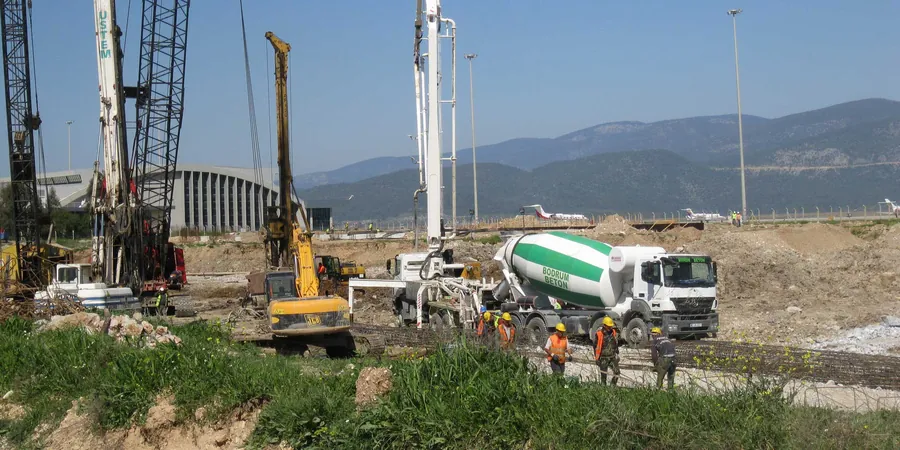
Pump concrete is not a separate strength class; the same C25/30 or C30/37 is produced with a different mix design if it is to be delivered by pump. The difference arises from the need for the concrete to travel hundreds of metres through a pipe, sometimes tens of metres upwards, without blocking or segregating.
Concrete moving through a pipe slides on a thin layer of paste that clings to the pipe wall. If there are not enough fines to form this lubricating layer, the coarse aggregate rubs against the wall, the water separates from the paste and runs ahead, the stones lock up behind and the pump blocks. This is why the proportion of fines (cement, mineral additions, fine sand) in pump concrete is deliberately kept high; the sand content is increased compared with mass concrete; the maximum size of the coarse aggregate is limited so that it does not exceed roughly one third of the pipe diameter; and the grading is arranged to be continuous. Flaky and elongated particles impair pumpability; cubical crushed stone is preferred.
The second difference is the admixture. In pump concrete the consistency is usually in the S3-S4 range, and it is achieved with superplasticiser, not water. The admixture lubricates the paste by dispersing the cement particles; it gives flow without raising the water/cement ratio. On long lines and in tall buildings a set retarder may also be added to offset consistency loss. Some mixes also use viscosity-modifying admixtures that hold the water within the mix; these prevent the concrete bleeding in the pipe, that is, the water separating from the paste.
The third difference is the air content. A small amount of entrained air increases the lubricity of the mix and makes pumping easier; too much air, however, compresses in the pump piston and causes a loss of pressure. The plant strikes this balance in the mix design.
Pump concrete is also handled differently on site. Before the pump line starts work, the inside of the pipe is lubricated with a slippery paste or mortar; this first mortar is not poured into the structure. The concrete left at the end of the line goes to a waste point, not into the structural element. The pump hose does not discharge the concrete from a height; the concrete is placed with the shortest possible drop height and with the end of the hose kept inside the concrete, otherwise the coarse particles segregate. During long pauses the concrete begins to set in the pipe; when there is a break, the line is cleaned.
Adding Water on Site: Why Is It Strictly Prohibited?
The truck mixer has arrived on site and the concrete looks stiffer than you expected; asking the driver for a bucket of water is the easy option. What that bucket does to the concrete is simple: it raises the water/cement ratio. Every extra litre of water remains in the cement paste as a surplus that takes no part in hardening and leaves a void when it dries. As voids increase, strength falls, permeability rises, shrinkage grows and the reinforcement is exposed to corrosion. Adding 30-40 litres of water to a truckload of concrete raises the consistency by one class while cutting a considerable share off the 28-day strength. We set out the mechanism of this relationship with figures in the article on the water/cement ratio and concrete strength.
There is a legal side too. The standard prohibits adding water to concrete after delivery; concrete to which water has been added falls outside the plant's guarantee. If the target strength is not achieved when the sample cube is crushed, responsibility passes to the party that added the water. This is why building inspection and delivery records include a line asking "was water added".
So what should you do if the concrete really did arrive stiff? First, carry out a slump test on site and compare the result with the ordered class; the concrete is usually within the ordered class and the sense of stiffness is a matter of expectation. Second, if the result is below the class, call the plant; with the approval of the plant's representative, a measured amount of superplasticiser can be added into the truck mixer and mixed for long enough to raise the consistency without upsetting the water/cement ratio. Third, on subsequent orders move the class up one step; the problem is not asking for the right consistency, not the absence of water in the truck mixer.
Self-Compacting Concrete in Brief
Self-compacting concrete is concrete that flows under its own weight without a vibrator, fills every corner of the formwork, envelops dense reinforcement and does all this without segregating. It cannot be measured with the slump test; when the cone is lifted the concrete spreads out completely. Instead, the spread diameter (slump-flow test), flow time and passing ability are measured. TS EN 206 defines it by slump-flow classes such as SF1, SF2 and SF3, with spread diameters ranging from 550 mm to 850 mm.
Its flowability comes not from water but from a high dose of superplasticiser, a high proportion of fines (mineral additions, stone dust) and a viscosity-modifying admixture. As a result it flows like water while the coarse particles stay suspended in the paste. Where it is needed: heavily reinforced joints, thin, tall walls, closed sections the vibrator poker cannot reach, architectural fair-faced concrete surfaces (where vibrator marks and air voids are unwanted), and night pours with noise restrictions. The pressure on the formwork is higher than with normal concrete; the formwork must be designed accordingly. The mix cost is high, but the savings in vibration labour, surface finishing and speed close the gap on some jobs.
Asking for the Right Consistency in the Order
Decide on consistency when ordering, not when the truck mixer arrives at the gate. State the following clearly in the order: strength class (for example C30/37), exposure class, consistency class or target slump (for example S3 or 140 mm), maximum aggregate size (for example 22 mm), delivery method (pump or direct from the truck mixer), pump line length and height, pour time and estimated duration. With this information the plant adjusts the admixture dosage for haul time and air temperature, and the concrete arrives on site at the consistency you want.
At delivery, check the consistency class on the delivery note, carry out a slump test on the first truck, record the result and take specimens for strength testing. If the consistency differs from what you expected, use the telephone, not water. At Bodrum Beton we adjust the consistency at the plant to your site conditions on every order, pump concrete included, and deliver the concrete by pump right to the formwork; for consistency and mix advice before ordering you can reach us through our contact page.
Frequently asked questions
What should the slump value be?
There is no single correct value; it varies with the element and the placing method. In residential and commercial buildings, S3 (100-150 mm) is the most common choice for columns, beams and slabs. S4 is preferred in heavily reinforced and thin sections, S2 for ground slabs and sloping surfaces. If the project specification states a value, that value is followed.
The concrete arrived stiff, what happens if I add a little water?
The water/cement ratio rises, strength falls, permeability and shrinkage increase. The plant's responsibility also lapses; if the sample strength comes out low, responsibility passes to the party that added the water. The right course is to verify the class with a slump test and, if necessary, add plasticiser in the truck mixer with the plant's approval.
Why is pump concrete priced differently?
Because pump concrete contains more fines and superplasticiser for the same strength class, the mix cost is somewhat different; the pump service is also a separate item. In return, the placing speed, labour savings and ease of reaching the formwork more than cover this difference on most projects.
Who should carry out the slump test, and once every how many trucks?
The test can be carried out by the plant's quality staff, the building inspection officer or trained site personnel. It is recommended on the first truck for small pours, and on every truck sampled or at set intervals for large pours. Slump should also be measured every time a strength specimen is taken; the two are recorded together.
How quickly does consistency loss occur, how many hours can concrete wait in the truck mixer?
Consistency starts to fall from the moment of mixing, and falls faster in hot weather. As a general rule, the aim is for the concrete to be placed within roughly two hours of its first contact with the mixing water; where a set retarder is used, this period can be extended. Restoring the consistency of concrete waiting in the truck mixer with water is prohibited.
Can self-compacting concrete be used on every job?
Technically yes, economically not always. It has a clear advantage in situations such as dense reinforcement, thin sections, formwork without vibrator access and fair-faced concrete surfaces. On sloping surfaces and in standard slabs, however, its flowability becomes a disadvantage, and the formwork pressure is higher than with normal concrete.
Related articles
Choosing a Concrete Pump: Boom, Line Pump and the Access Plan

Formwork Striking Times: When to Strike, and the Risk of Early Loading

Industrial Floor Concrete: Hardener, Joints and Flatness
Concrete Cracks: Types, Causes and Ways to Prevent Them
Pouring Concrete in Winter: Cold-Weather Precautions and Freezing Risk
Water/Cement Ratio: Why Does Excess Water Weaken Concrete?
How to Order Concrete: m³ Calculation, Pump Selection and Pour Day
What Is Concrete Curing? A Guide to Hot-Weather Pouring and Curing
Need concrete for your project?
Contact our sales team for mix design, delivery planning and a price quote. Fast delivery from our Milas / Muğla plants to the Bodrum, Milas, Ören and Güllük line.